No established digital workflow
For most onboarding tasks, there is no end-to-end BPP system. Spreadsheets fill the gap, and the gap has been there long enough for the workarounds to feel like the process.
Defined a product strategy and prototyped a product for a 13,000-apprentice onboarding service, reducing operational friction for clients, apprentices, and BPP Operations, and compressing the 6-week onboarding window.
BPP runs apprenticeship programmes for major UK employers across professional services, financial services, and the public sector, onboarding ~13k learners per year against DfE compliance rules and individual client SLAs.
Onboarding sits between Join (application) and Learn (the programme itself). It looks simple from the outside. From the inside, it spans multiple teams, schools, and systems, with little shared visibility of what's consistent, what varies, and where time is being lost.
Behind that 6-week cycle and the 70 FTEs sits the real reason it costs what it does. Every learner ends in the same place: onboarded, booked, ready to study. But the path each takes depends on which client segment funded them, which school owns the programme, and which spreadsheet is currently the source of truth.
Five segments. Five operating realities. One outcome, reached differently every time.
Before BPP could prioritise where to invest, it needed a shared, ground-truth picture of how onboarding actually ran: what was consistent, what varied, where time was being lost, and which gaps were process versus tooling.
The work was framed as a 3-month diagnostic engagement: find the friction, quantify it where possible, and recommend a prioritised set of changes that would move the needle on cost, capacity, and client experience.
I owned the discovery and prioritisation work for BPP's P&T Academic Life team: 50+ stakeholders through workshops, and a to-be journey prototype built in Claude.
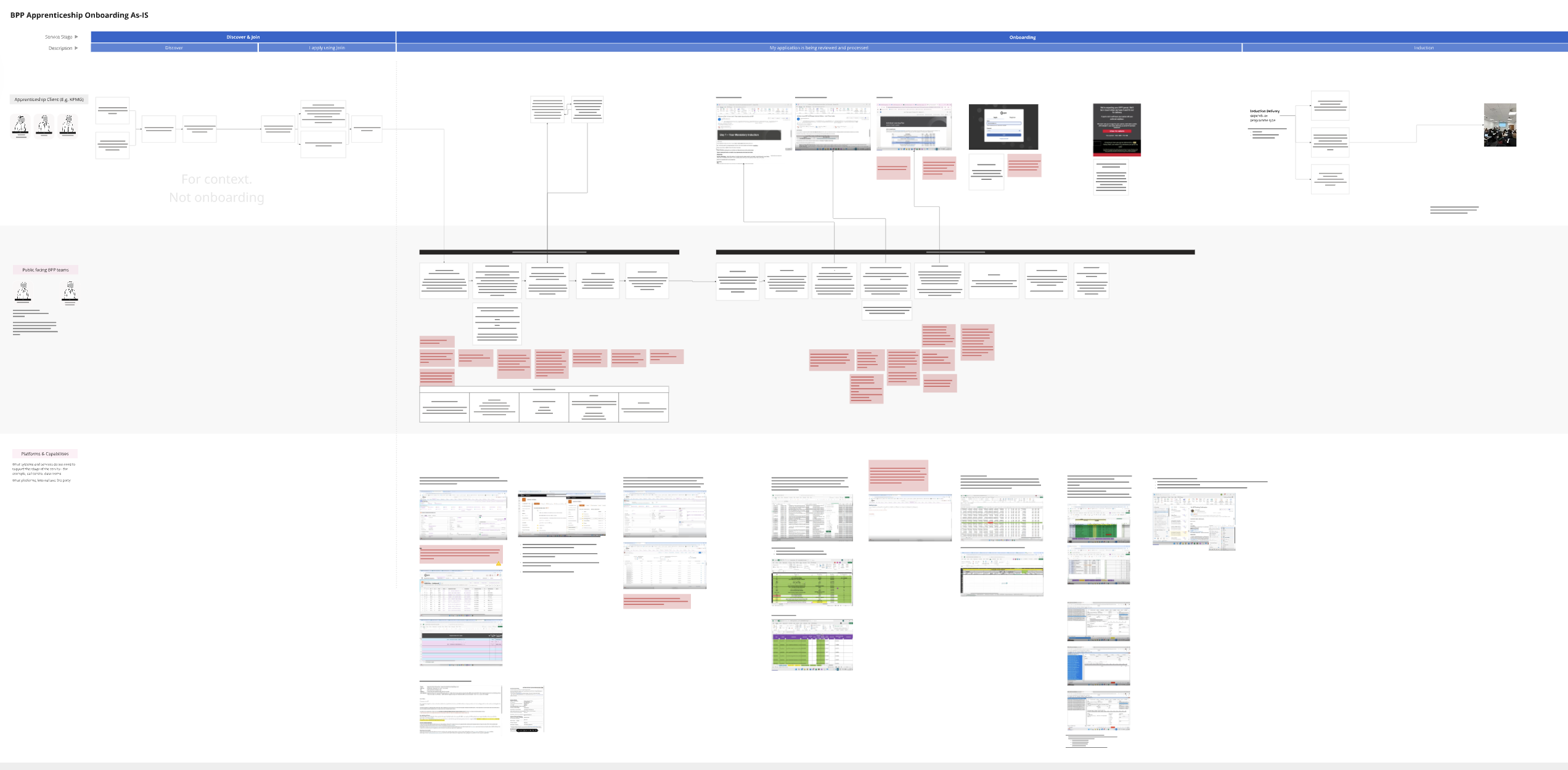
A working synthesis of the as-is service: client-facing teams above the line, BPP's internal teams and the platforms they depend on below. Friction points (in red) were captured across 71 FTEs and 25+ tools to make the lived service legible to a leadership team that had never seen it end-to-end.
The learner. Studies with BPP while employed by the client. Needs clarity on day-one logistics, timetables, materials.
Approves the apprentice's enrolment and tracks progress. Required gateway for booking onto programme.
In larger client orgs, primary liaison. Often the main point of contact for new graduates without an assigned line manager yet.
Procurement-side ownership. Holds BPP accountable to SLAs and contractual training delivery.
Owns the client account. Responsible for SLA delivery, account growth, and revenue across one or several segments.
Compliance and eligibility. Ensures DfE rules are met and funding can be drawn down on time.
Books learners onto programmes. Manages timetables, Hub access, materials, induction comms.
Builds learner timetables. Sends out books, materials, and third-party platform logins.
A condensed view of the JTBD board built during discovery. Cards are colour-coded by persona and clustered by phase of the onboarding journey.
Full board mapped 30+ jobs across 5 personas and 4 phases. The cards above are a representative sample chosen for clarity.
The 6-week onboarding window splits cleanly into two phases. Each has its own bottlenecks. Most of them aren't where the org thinks they are.
Across every team I shadowed, the same pattern emerged: where digital tools couldn't be trusted, spreadsheets stepped in. They are the most honest signal the org has about where the system is failing.
"We've refined these spreadsheets over the years."
— BPP Operations team
For most onboarding tasks, there is no end-to-end BPP system. Spreadsheets fill the gap, and the gap has been there long enough for the workarounds to feel like the process.
Programme details (start dates, end dates, modules) live in both Salesforce and school-owned spreadsheets, and don't always agree. Staff manually compare the two, increasing the risk of errors, delays, and miscommunication.
For some accounts, BPP's spreadsheets are the client-facing reporting layer. Clients update learner emails inside them; some IT teams only release working emails on the apprentice's first day, breaking the comms chain.
Each painpoint cluster was reframed into a testable solution hypothesis, tagged with the type of impact it would unlock and the type of change it would require. This gave the P&T leadership team a shared lens for prioritisation, and a way to sequence Process work against Technology work.
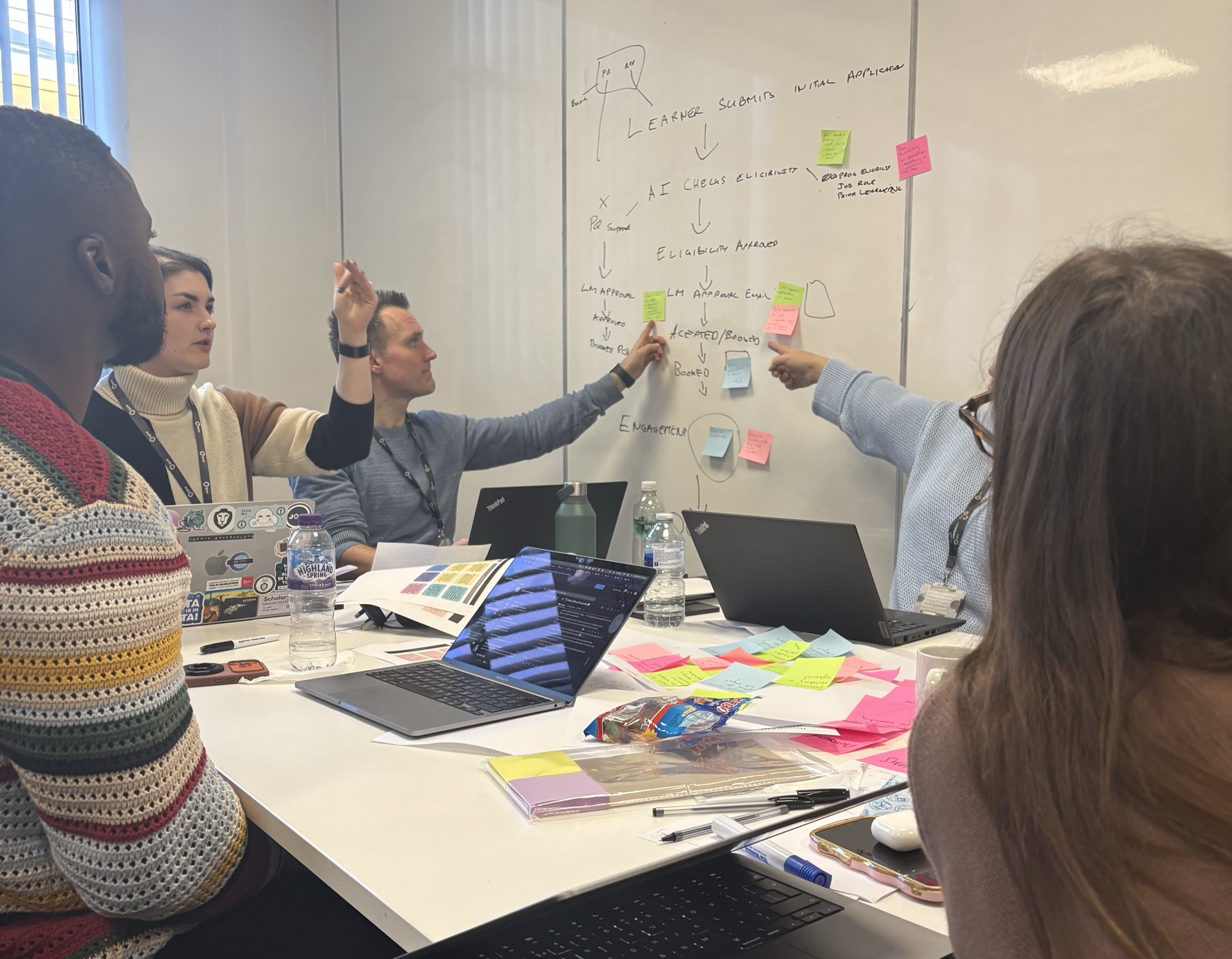
Hypotheses weren't designed in isolation. Painpoint clusters were reframed as How Might We statements and taken into a workshop with the people who actually run the service (Apprenticeship Operations, Client Ops, Scheduling & Resources, and the P&T product team) so the solution space was generated by the teams who'd own the change.
Matching the company and learner during onboarding requires manual checks and email exchanges with the client.
If the application starts in Client Hub and the learner is automatically linked to the client record, audit time will reduce.
51% of application and onboarding lead time is spent on hold.
If onboarding checks and notifications to learners and line managers are automated, the time spent on hold will be reduced.
Client Operations spend, on average, 26 hours per week on manual booking tasks.
If learners are automatically booked onto programme once their application is complete, manual booking work is removed.
Clients lack real-time visibility of cohort progression, driving query volume and reliance on email + spreadsheets.
If clients have live visibility of their cohorts, trust and professionalism will improve, and time from application to booking will reduce.
Spreadsheets used for onboarding and bookings create duplicate data and increase reconciliation time.
If Client Operations manage bookings through a Salesforce-fronted UI, duplicate data and manual reconciliation are removed and processing speeds up.
Ranking by impact was the easy part. The harder question was what could plausibly ship first, given the operational, political, and platform constraints discovery had surfaced.
Schools operated semi-independently, making process standardisation politically sensitive.
Salesforce ownership was distributed across teams, limiting the speed of workflow changes.
Some spreadsheet workflows persisted because clients themselves depended on them operationally.
Automation opportunities were constrained by inconsistent upstream programme data.
Hypotheses were sequenced into three waves, chosen so that each wave de-risked the next, kept clients running on the workflows they depended on, and gave Salesforce owners time to coordinate.
Identify the sub-stages within Phase 1 (eligibility checks, contract chasing, document parsing, induction triggers) that can be handled by agentic AI without changes to Salesforce or Client Hub. Highest-impact manual tasks first, lowest platform risk.
Agentic AI · low platform riskAuto-link the learner to the client record at application start, removing manual audit time. Clean upstream programme data (start dates, end dates, modules) so the AI in Wave 01 keeps scaling on trustworthy inputs.
Technology · upstream dependencySalesforce-fronted bookings across the full onboarding flow, with end-to-end automated eligibility. Held until Wave 02 has shipped clean data, and clients have been migrated off shared trackers in parallel, avoiding breaking the workflows they currently depend on.
Technology & process · co-designed with clientsTo anchor the strategy in something concrete, I shipped a 10-step interactive prototype of the to-be onboarding journey, built in Claude in days rather than weeks. The prototype covered both client and BPP user lanes, and became the leadership alignment artefact: real, clickable, and used to ground scope, sequencing, and procurement decisions.
Each hypothesis was modelled against the operational baseline (current lead time, time-on-hold, manual booking hours, and comms volume) to give P&T leadership a plausible upside range to prioritise against.
Projections · directional, modelled from baseline data captured during discovery.
Driven by automated eligibility checks and removal of manual chasing across Phase 1.
Automated checks and proactive notifications replace the manual reconcile-and-chase loop.
Auto-booking on application complete removes the spreadsheet and Salesforce reconciliation step.
Live cohort visibility removes the "where are we up to?" email cycle from Training Coordinators.